← Library
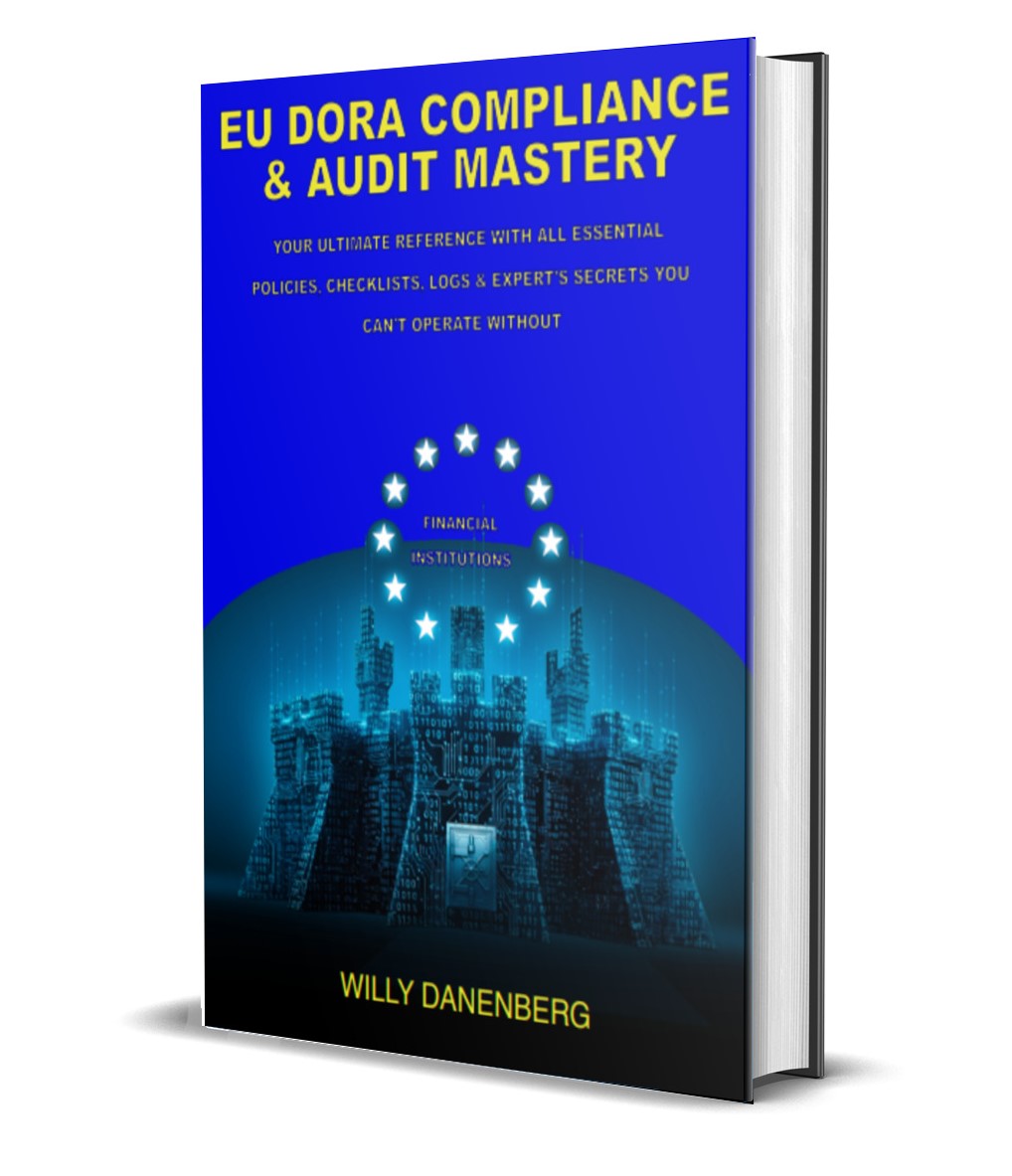
DORA COMPLIANCE & AUDIT MASTERY -
Willy Danenberg
DORA Compliance Series
Progress7/130
1 Introduction πŸ”’ Praise for the book DORA COMPLIANCE & Audit Mastery πŸ”’ 15 Key Recommendations for DORA Success πŸ”’ Disclaimers & Legal Notices πŸ”’ Trademark Disclaimer πŸ”’ Consulting Services πŸ”’ Part I - Orientation & Foundations (Why & How to Think About DORA) πŸ”’ Chapter 1: Why the EU Created DORA - The Systemic Risk Imperative πŸ”’ Chapter 2: Who Must Comply and the Consequences of Audit Failure πŸ”’ Chapter 3: The Legal Architecture: Regulation 2022/2554 + the Three RTS Explained πŸ”’ Chapter VI - Information-sharing arrangements πŸ”’ Chapter 4: Policies as the Backbone of Compliance - Introducing the P1-P53 Catalogue πŸ”’ Chapter 5: The PDCA Cycle + Evidence-First + PRACI Accountability Model πŸ”’ Chapter 6: Management Body & Board Accountability under DORA (Art. 5) πŸ”’ Chapter 7: The Three Lines of Defence Reimagined with PRACI πŸ”’ Chapter 8: Required Governance Bodies & Escalation Paths πŸ”’ Chapter 9: The DORA Operating Model - Decision & Evidence Flows πŸ”’ Chapter 10: Policy Governance Lifecycle πŸ”’ Chapter 11: ICT Risk Management & Resilience Strategy Policies (P1-P3) πŸ”’ Chapter 12: Security & Protection Controls (P4-P13, P43, P49, P52) πŸ”’ Chapter 13: Business Continuity & Recovery Policies (P14-P23, P53) πŸ”’ Chapter 14: Incident Detection, Classification & Reporting (P24-P27, P46) πŸ”’ Chapter 15: Change, Configuration & Secure Development (P8, P25, P30, P37, P43, P47) πŸ”’ Chapter 16: Third-Party ICT Risk & Cloud Governance (P32-P37, P39, P42, P50, P51) πŸ”’ Chapter 17: Architecture, Interdependency & Documentation (P20, P38, P45, P51, P53) πŸ”’ Chapter 18: GDPR-DORA Intersections & Conflict Resolution πŸ”’ Chapter 19: From Policy to Procedures, Playbooks & Runbooks πŸ”’ Chapter 20: Building the Central DORA Evidence Repository πŸ”’ Chapter 21: The DORA Logs Catalogue - Mandatory Fields & Retention πŸ”’ Chapter 22: Dependency Mapping & Recovery Sequencing Workshop πŸ”’ Chapter 23: Immutable Backups, Cyber Vaults & Clean-Room Recovery πŸ”’ Chapter 24: Operationalising Third-Party Providers - Evidence Flows & Contract Management πŸ”’ Chapter 25: Continuous Monitoring & Telemetry Requirements πŸ”’ Chapter 26: The Full DORA Testing Programme - From Basic Tests to TLPT πŸ”’ Chapter 27: How a Real DORA Supervisory Review is Conducted - Day-by-Day Playbook πŸ”’ Chapter 28: Master Audit Checklists by Policy Family πŸ”’ Chapter 29: Evidence Packages That Pass Audits - 12 Ready-to-Use Examples πŸ”’ Chapter 30: Your First DORA Audit - Everything You Must Prepare & Exactly How to Answer the Regulator’s Questions πŸ”’ Part VI - Continuous Improvement & Maturity (ACT) πŸ”’ Chapter 31: Post-Incident Reviews & Lessons-Learned Process πŸ”’ Chapter 32: The Multi-Year DORA Roadmap & Remediation Governance πŸ”’ Chapter 33: DORA Maturity Model (Level 1-5) + Self-Assessment Framework πŸ”’ Chapter 34: Embedding DORA into Culture, Training & Awareness πŸ”’ Part VII - Role-by-Role DORA Playbooks πŸ”’ Chapter 35: Board of Directors & Management Body Playbook πŸ”’ Chapter 36: Chief Information Officer (CIO) Playbook πŸ”’ Chapter 37: Chief Information Security Officer (CISO) Playbook πŸ”’ Chapter 38: Chief Risk Officer (CRO) / Risk Function Playbook πŸ”’ Chapter 39: Chief Technology Officer (CTO) / Chief Architect Playbook πŸ”’ Chapter 40: Chief Operations Officer (COO) / Head of IT Operations Playbook πŸ”’ Chapter 41: Data Protection Officer (DPO) & Legal/Compliance Playbook πŸ”’ Chapter 42: Head of Third-Party / Vendor Risk Management Playbook πŸ”’ Chapter 43: Head of Resilience & Business Continuity Playbook πŸ”’ Chapter 44: SOC / CSIRT Leader Playbook πŸ”’ Chapter 45: Internal Audit Lead Playbook πŸ”’ Chapter 46: Business Unit & Product Owners Playbook πŸ”’ Chapter 47: Master PRACI Matrix (53 Γ— 18 roles) πŸ”’ Chapter 48: Interdependency & Recovery Sequencing Matrices πŸ”’ Chapter 49: Incident-to-Policy & Stakeholder Engagement Matrices πŸ”’ Chapter 50: Complete DORA Logs & Evidence Catalogue πŸ”’ Chapter 51: GDPR-DORA Cross-Mapping Tables πŸ”’ Chapter 52: All Audit Checklists (grouped) πŸ”’ Chapter 53: 12 Evidence Package Templates πŸ”’ Chapter 54: Policy, Procedure & Runbook Templates (text-based) πŸ”’ Chapter 55: Course Curriculum & Module Mapping πŸ”’ Chapter 56: What the Course Adds (tools, workshops, certification) πŸ”’ Part VIII - Complete Policy Reference Library (P1-P53) πŸ”’ Policy P1: ICT Risk Management Framework Policy πŸ”’ Policy P2: Digital Operational Resilience Strategy πŸ”’ Policy P3: ICT Risk Appetite & Tolerance Policy πŸ”’ Policy P4: Information Security Policy πŸ”’ Policy P5: Identity and Access Management Policy πŸ”’ Policy P6: Cryptographic Key Management Policy πŸ”’ Policy P7: Cryptographic Key & Secrets Management Policy πŸ”’ Policy P8: Change + Patch & Vulnerability Management Policy πŸ”’ Policy P9: Network Security & Segmentation Policy πŸ”’ Policy P10: Endpoint & Mobile Device Management Policy πŸ”’ Policy P11: SSL/TLS Certificate Management Policy πŸ”’ Policy P12: Secure Document Management Policy πŸ”’ Policy P13: ICT Security Monitoring & Detection Policy πŸ”’ Policy P14: ICT Business Continuity Policy πŸ”’ Policy P15: RTO/RPO Policy πŸ”’ Policy P16: ICT Response & Recovery Playbooks πŸ”’ Policy P17: Enterprise Backup & Recovery Policy πŸ”’ Policy P18: Ransomware Resilience & Immutable Back up πŸ”’ Policy P19: Data Consistency & Integrity Assurance Policy πŸ”’ Policy P20: Personal Data Breach Response Policy (GDPR + DORA) πŸ”’ Policy P21: Cyber Vault & Clean-Room Recovery Policy πŸ”’ Policy P22: Backup, Recovery & Resilience Testing Policy πŸ”’ Policy P23: Crisis Management & Communication Policy πŸ”’ Policy P24: ICT-Related Incident Management Process Policy πŸ”’ Policy P25: Incident & Cyber-Threat Classification Policy πŸ”’ Policy P26: Major ICT-Related Incident Reporting Policy πŸ”’ Policy P27: Post-Incident Review & Remediation Policy πŸ”’ Policy P28: Digital Operational Resilience Testing Programme Policy πŸ”’ Policy P29: Annual Penetration Testing Policy (non-TLPT) πŸ”’ Policy P30: Threat-Led Penetration Testing (TLPT) Policy πŸ”’ Policy P31: Tester Independence & Qualification Policy πŸ”’ Policy P32: ICT Third-Party Risk Strategy πŸ”’ Policy P33: Register of ICT Third-Party Arrangements & Ongoing Monitoring Policy πŸ”’ Policy P34: ICT Concentration Risk & Substitutability Assessment Policy πŸ”’ Policy P35: Standard Contractual Clauses & Contract Management Policy πŸ”’ Policy P36: Exit Strategy & Transition Policy πŸ”’ Policy P37: Third-Party Software & Open-Source Component Risk Policy (SBOM) πŸ”’ Policy P38: DORA Document Management & Record-Keeping Policy πŸ”’ Policy P39: Vendor Onboarding & Due Diligence Policy πŸ”’ Policy P40: ICT Security Awareness & Digital Resilience Training Policy πŸ”’ Policy P41: Cyber Threat Intelligence & Information-Sharing Policy πŸ”’ Policy P42: ICT Supply-Chain Security Policy πŸ”’ Policy P43: Secure Coding & Software Development Policy πŸ”’ Policy P44: DORA Policy on Policies πŸ”’ Policy P45: ICT Architecture & Dependency Mapping Policy πŸ”’ Policy P46: ICT Logging & Forensic Readiness Policy πŸ”’ Policy P47: Change Advisory Board (CAB) & Emergency Change Rules πŸ”’ Policy P48: Data Classification & Protection Policy πŸ”’ Policy P49: ICT Configuration Hardening Baseline Policy πŸ”’ Policy P50: Data Location, Sovereignty and Cloud Transparency Policy πŸ”’ Policy P51: ICT Documentation, Architecture Records, Inventories and Evidence Governance Policy πŸ”’ Policy P52: Physical Security Policy πŸ”’ Policy P53: Interdependency, Recovery Sequencing & Continuity Assurance Policy πŸ”’ Annexes πŸ”’ A3 - Glossary of Key DORA Terms An alphabetical glossary of essential DORA terminology, with simplified definitions, practical examples, and direct references to relevant articles or policies for rapid lookup. πŸ”’ A1 -DORA Visual Summary (laminate this) πŸ”’ A2 - PRACI Cheat Sheet (expanded with examples, pitfalls, and best practices πŸ”’ A4 - Expanded Maturity Self-Check (20 questions - score 1-5 each, with explanations & action tips) πŸ”’ Level 1: Initial πŸ”’ Level 2: Developing πŸ”’ Level 3: Established πŸ”’ Level 4: Advanced πŸ”’ Level 5: Optimized
πŸ“¦ Amazon Print πŸ›’ Digital β€” €14.95
DORA COMPLIANCE & AUDIT MASTERY - β€Ί Part I - Orientation & Foundations (Why & How to Think About DORA)
πŸ‘ Tenant πŸ”“ Full
Part 7 / 130

Part I - Orientation & Foundations (Why & How to Think About DORA)

Introduction to Part I This first part is written for complete beginners. Imagine you have just left school or university and started your first job in a bank, insurance company, payment provider, or any other financial organisation in Europe. You do not need any previous knowledge of technology, law, or finance. Every new term will be explained the first time it appears, exactly as if you were hearing it for the first time. By the end of these five chapters you will understand why DORA was created, who has to follow it, how the law is built, why written policies are the most important tool, and the three simple thinking models (PDCA cycle, evidence-first mindset, and PRACI accountability) that make everything else in the book easy to follow.

πŸ”’
Full access required
Purchase the full edition to read all 130 chapters of this book.
BBB GRC Platform
v1.0.0
⏻
πŸ” Esc
No results found
πŸ“‹ My Tasks
GRC OK - 2026-04-23 05:38:55