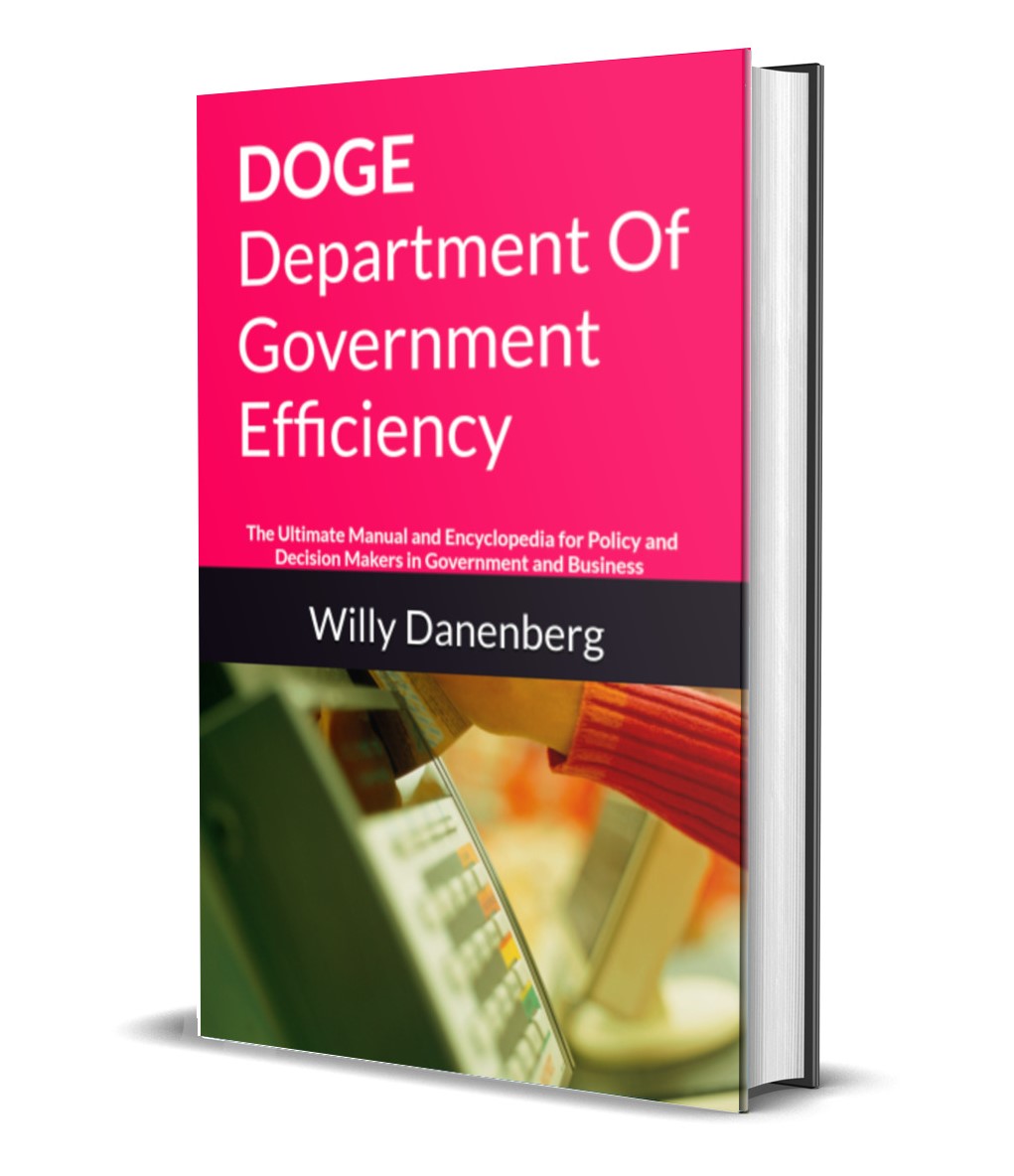
Introduction
The Ultimate Survival Manual and Encyclopedia for Leaders, Policy, and Decision Makers in Government and BusinessWritten by a Global Expert in Organizational Policy, Efficiency, Data Analysis, Lean Strategies, Change Management, AI, and Systematic Innovation.
AI, data supremacy, and rapid transformation are redefining Governance, Risk, and Compliance (GRC). Leaders who fail to adapt will not just struggle - they will be eliminated. This book delivers the critical strategies and actionable plans needed to decode the present, anticipate the future, and redesign governments and businesses for survival.
Change is often brutal. As seen with Elon Musk’s sweeping overhauls in both government and industry, bureaucracies are being dismantled, inefficiencies exposed, and leadership redefined. This is not just a guide—it is a survival manual for those who must transform their organizations to provide ever increasing value of services, protect their influence, and maintain order in an age of relentless disruption.
Copyright Notice
© 2025 Willy DANENBERG All rights reserved.
No part of this publication may be reproduced, distributed, or transmitted in any form or by any means, including photocopying, recording, or other electronic or mechanical methods, without the prior written permission of the author, except in the case of brief quotations embodied in critical reviews and certain other noncommercial uses permitted by copyright law. For permission requests, please contact the author via Linkedin at:
https://www.linkedin.com/in/willydanenberg/
This book is provided for informational purposes only. The views and opinions expressed in this work are those of the author and do not necessarily reflect those of any organization, company, or entity mentioned within.
The information presented in this book is provided “as is” and without warranties of any kind, either express or implied. While the author has made every effort to ensure accuracy, no guarantee is given regarding the completeness, reliability, or applicability of the content.
The author is not responsible for any errors, omissions, or any outcomes related to the use of this material. Any reliance placed on the information in this book is strictly at the reader’s own risk. This work is not intended as legal, financial, political or professional advice. Readers are encouraged to seek professional counsel when making decisions based on the concepts discussed herein.
Furthermore, the predictions, assessments, and analyses in this book are based on the author’s research and personal insights at the time of writing. Given the rapidly evolving nature of technology, government policies, and business practices, some information may become outdated. The author does not assume responsibility for changes in circumstances that may affect the accuracy of the material provided.
This book is intended to foster discussion and critical thinking and should not be interpreted as advocating for or against any political, corporate, or social entity or policy. The author remains neutral on all political affiliations and does not endorse any political figure, company, or organization mentioned in this work.
Trademark Notice
All trademarks, product names, and company names or logos mentioned in this book are the property of their respective owners. The use of such names is for identification and reference purposes only and does not imply any endorsement, affiliation, or sponsorship by the trademark owners.
The author has no official connection with any companies, individuals, or institutions mentioned in this work. Any references to third-party entities are made purely for illustrative or educational purposes and should not be construed as statements of fact beyond the scope of general analysis and commentary.
If you believe that any content within this book infringes on copyright, trademark, or intellectual property rights, please contact the author via
https://www.linkedin.com/in/willydanenberg/
to address the matter accordingly.
Fair Use and Liability Disclaimer
This book contains references to various companies, industries, and technological trends for the purposes of commentary, education, and analysis. Any mention of specific companies, organizations, or technologies is intended to provide illustrative examples and does not constitute endorsement, sponsorship, or affiliation.
Furthermore, while some scenarios, case studies, or narratives may resemble real-world companies or events, they are used in a transformative manner to encourage reflection, critique, and analysis. Any resemblance to actual businesses, persons, or events—past or present—is either purely coincidental or falls within the boundaries of fair use for educational, research, and public discussion purposes.
The content of this book is presented in good faith and in accordance with the principles of fair use and citation rights under applicable laws. Readers are encouraged to independently verify any information or perspectives discussed in this work.
About This Book
In a world where technological advancements, data-driven decision-making, and AI-driven automation are transforming industries and governments at an unprecedented pace, inefficiencies are no longer tolerable. DOGE: Department of Government Efficiency is a deep exploration of how modern governance, corporate structures, and bureaucratic systems are being reshaped by “executive unrestricted data access bypass”, innovation, data analysis, and lean process improvements.
For decades, inefficiencies in public administration, corporate governance, and regulatory systems have been seen as inevitable. Organizations have relied on complex structures that manage inefficiencies rather than eliminating them. However, the rise of figures like Elon Musk and forward-thinking nations demonstrates that governments and corporations no longer need to accept systemic inefficiencies—they can completely redesign them or even eliminate them.
This book is not just about pointing out the problems; it provides a structured framework for understanding and applying modern efficiency models. Drawing from Lean Six Sigma, process optimization strategies, AI integration, and data-driven decision-making, DOGE: Department of Government Efficiency explores:
The balance between efficiency and effectiveness in governance and business.
How the elimination of constraints, full data access, and AI-driven automation are disrupting outdated bureaucratic models.
The growing divide between productive work and "bullshit jobs" as AI and automation replace redundant human labor and the potential impact on each one of us.
The hidden factory effect, where governments and organizations spend resources fixing inefficiencies instead of preventing them at their origin.
The geopolitical and economic consequences of rapid government and corporate transformation.
This book is the result of 35 years of experience and research in process improvement, cultural transformation, and organizational strategy. It provides readers—whether they are policymakers, business leaders, or individuals trying to navigate a rapidly changing world—with practical insights and strategic approaches to adapt to the new era of efficiency.
Change is coming faster and can be as brutal as it can get, more than most institutions are prepared for. DOGE: Department of Government Efficiency is a roadmap for understanding and thriving in this new reality.
About the Author – Willy Danenberg
Willy Danenberg is a global expert in process optimization, cultural transformation, and efficiency strategies, with over 35 years of experience in business, governance, IT, and organizational change. Throughout his career, he has helped businesses, governments, and institutions streamline their operations, eliminate waste, and implement data-driven decision-making processes.
Danenberg's expertise in Lean Six Sigma, automation, and AI-driven efficiency models has made him a leading voice in the field of modern governance and corporate transformation. His work spans cultural change initiatives, process reengineering, and large-scale organizational restructuring.
He has spent decades studying the hidden inefficiencies that cripple governments and corporations, researching how systemic flaws are perpetuated through outdated processes, regulatory stagnation, and bureaucratic inertia. His mission is to help organizations and individuals navigate the rapidly evolving landscape of automation, AI-driven optimization, and efficiency-driven decision-making.
In addition to DOGE: Department of Government Efficiency, he is also the author of Change Instinct, a book that explores how individuals and businesses can develop the ability to adapt to change instinctively, intelligently, and rapidly.
As a speaker, consultant, and thought leader, Danenberg continues to advise organizations worldwide on how to prepare for a future where adaptability and efficiency are no longer optional—they are the foundation of success.
He believes that the world is moving toward a reality where inefficiencies are no longer tolerated, and those who fail to adapt will be left behind. His books serve as practical guides to understanding, anticipating, and mastering the coming wave of transformation.
For more information about Willy Danenberg and his work, contact Willy DANENBERG via Linkedin
Books by the same AuthorChange Instinct: Mastering the Art of Adaptability in a Rapidly Evolving World In "Change Instinct," embark on a transformative journey to master the art of informed and instinctive change. This compelling read delves into the critical importance of adaptability, innovation, and continuous improvement in both personal and professional spheres. Drawing from a rich tapestry of methodologies including TRIZ, Lean, Six Sigma, Total Quality Management, Data Management, Cybersecurity, IT, psychology, change management coaching, cultural change, and soft skills "Change Instinct" provides practical tools and strategies to navigate complex challenges, foster a culture of collaboration, and drive sustainable success. What sets this book apart is its engaging and captivating narrative. Each page is filled with fascinating stories and insights that make it impossible to put down. Whether you're a manager, consultant, coach, entrepreneur, worker, or lifelong learner, this book offers invaluable insights to help you thrive in an ever-evolving world. Dive in and discover how to harness the power of change to elevate your life and career while thoroughly enjoying the journey.
The Compliance Trap: A Cyber Data Protection (GDPR) Thriller in a World of Digital Threats Why Should You Read This Book? For the thrill – If you love edge-of-your-seat action, deep conspiracies, and daring escapes, you’re in the right place. For the knowledge – While the story is fiction, the risks are very real. By the time you turn the last page, you'll see the internet differently.For the future – Whether you're an everyday internet user, a business leader, or a privacy-conscious professional, understanding data protection is no longer optional—it’s survival. A Must-Read for Cybersecurity, GDPR, and DORA Specialists. This book doesn’t just entertain—it dives deep into real-world challenges faced by cybersecurity professionals, GDPR compliance officers, and DORA (Digital Operational Resilience Act) specialists. If you work in data security, regulatory compliance, or digital risk management, you’ll find intriguing insights woven into the narrative. Several chapters explore regulatory interactions, investigations, and the real-world consequences of non-compliance, making this story as informative as it is gripping. From cybercriminals and rogue AIs to government surveillance and billion-dollar data heists, this book explores what happens when privacy is no longer private and the world’s most valuable assets – our information becomes a weapon. So, buckle up. The truth is out there. The question is: Are you ready for it?
Here are a few powerful, knowledge-packed phrases that align with the themes of this book:
"Efficiency is not just about doing things faster—it is about eliminating the need for unnecessary steps altogether."
"Governments and corporations have spent decades managing inefficiencies rather than eliminating them; AI and data-driven decision-making are now forcing a reckoning."
"The greatest innovation of our era is not a single technology—it is the removal of constraints that once made inefficiencies tolerable."
"The future will not be built by those who optimize outdated processes, but by those who recognize when to discard them entirely."
"Data is no longer a resource; it is the foundation of governance, business, and decision-making. Those who control data control reality."
"Automation does not just replace jobs; it rewrites the economic logic of industries, making some skills obsolete overnight."
"We no longer live in a world where inefficiencies are overlooked—they are being exposed in real-time, and those who fail to adapt will be left behind."
"The hidden factory—the world of unnecessary corrections, redundant approvals, and bureaucratic patchwork—is the greatest drain on modern economies."
"Artificial Intelligence is not replacing human intelligence—it is replacing human inefficiency."
"The power to act without constraints is the most valuable currency of the 21st century."
"The next great revolution is not industrial or digital—it is the optimization of governance, where inefficiency is no longer tolerated."
"There is no such thing as 'too big to fail' in a world where inefficiency is exposed and disrupted in real-time."
"Lean Six Sigma was designed to eliminate waste in manufacturing. Applied to governance, it will dismantle entire bureaucratic structures."
"Technology does not create problems—it reveals them. AI is simply making inefficiencies visible faster than governments can hide them."
"The greatest mistake of the modern era is assuming that systems built for the 20th century can function in the 21st."
"When the cost of maintaining an outdated system becomes greater than the cost of replacing it, revolution is inevitable."
"Efficiency is not the enemy of employment—it is the enemy of unnecessary work."
"Privileged data access is the new frontier of power—those who have it can shape history before the public even knows what has changed."
"The pace of change has outstripped the ability of institutions to adapt. The future belongs to those who can navigate uncertainty, not resist it."
"Bureaucracies are designed to ensure that decisions are never truly made—only managed. AI and data analysis have no patience for indecision."
Praise for DOGE: Department of Government Efficiency
"A groundbreaking analysis of inefficiencies in government and business, DOGE is a must-read for leaders looking to navigate the complexities of the modern world. A masterpiece of insight and practicality."
"This book is a wake-up call for policymakers and executives alike. It doesn’t just diagnose problems—it provides real, actionable solutions for systemic change."
"An essential guide for anyone who wants to understand the forces shaping our institutions today. The author's 35 years of experience shine through in every chapter."
"Brilliantly researched and expertly written, this book bridges the gap between theory and real-world application, making it indispensable for decision-makers everywhere."
"With clarity and conviction, DOGE lays out why traditional institutions are struggling and how they can evolve to meet the demands of a data-driven world."
"In a time of rapid technological and political disruption, this book offers a vital roadmap for those seeking to make their organizations more efficient and effective."
"The author’s deep understanding of Lean Six Sigma and process improvement is evident throughout this work, making it a valuable resource for professionals in any field."
"Few books manage to dissect the inner workings of government inefficiencies while also offering practical solutions. This is one of them, and it does so masterfully."
"An eye-opening exploration of how outdated systems persist and what we can do to replace them with smarter, more adaptive solutions."
"DOGE is an insightful look into the future of governance and business. It explains why traditional structures must change—and how we can make it happen."
"Elon Musk has revolutionized industries by eliminating inefficiencies, and this book explains how similar principles can be applied to governments and businesses worldwide."
"A compelling case for why governments and businesses must embrace data-driven decision-making to stay relevant in the modern era."
"A sharp, thoughtful, and practical guide to making large organizations work better. Every government official and corporate executive should read this book."
"This book takes complex ideas and makes them accessible, providing a much-needed perspective on how technology, data, and AI can transform bureaucratic systems."
"A rare book that is both deeply intellectual and immediately applicable. It challenges conventional thinking and offers a fresh vision for efficiency and effectiveness in governance."
"A game-changer for leaders who are serious about implementing real improvements. The lessons in this book are as relevant to multinational corporations as they are to government agencies."
"Unlike many books on government inefficiency, this one offer tangible, proven methodologies for improving operations. A true guide to the future of governance."
"The world is changing faster than ever, and this book shows how institutions can keep up. A must-read for those who refuse to be left behind."
"DOGE is more than a critique of inefficiency—it’s a blueprint for creating organizations that are resilient, agile, and ready for the challenges of the future."
"A timely and crucial book that reveals the structural inefficiencies plaguing modern institutions while offering clear, practical solutions. Highly recommended for forward-thinking leaders."